When you buy through links on our articles, Future and its syndication partners may earn a commission.

NASA's X-ray spacecraft XRISM, which stands for X-ray Imaging and Spectroscopy Mission, has clocked how fast winds are ripping from a distant galaxy bursting with star formation.
It would appear these winds travel at an incredible 2 million miles per hour (3.21 million kilometers per hour).
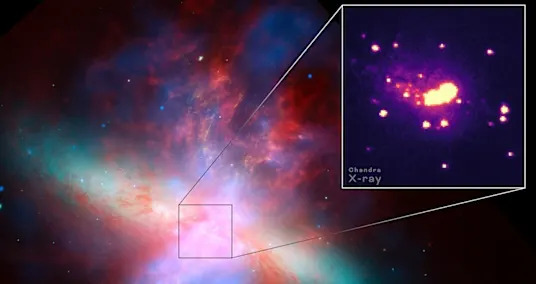
The superheated gas from this galaxy, Messier 82 (M82), flows from a region of intense stellar activity at the galaxy's heart. M82 is located around 12 million light-years away from us in the northern constellation Ursa Major and classified as a "starburst galaxy" because it is forming stars 10 times as rapidly as the Milky Way does.
"The classic model of starburst galaxies like M82 suggests that shock waves from star formation and supernovas near the center heat gas, kick-starting a powerful wind," team member Erin Boettcher, of the University of Maryland, College Park, and NASA’s Goddard Space Flight Center in Greenbelt, Maryland, said in a statement. "Prior to XRISM, though, we didn't have the ability to measure the velocities needed to test that hypothesis. Now we see the gas moving even faster than some models predict, more than enough to drive the wind all the way to the edge of the galaxy."
Boettcher measured the speed of these galactic winds using the XRISM (pronounced "crism") spacecraft's Resolve instrument.
Cigar galaxy has smoking hot winds
Also known as the Cigar Galaxy, M82 is known for its cool winds composed of vast amounts of gas and dust that stretch out for around 40,000 light-years. These winds have been observed with a wealth of space telescopes, including the Hubble Space Telescope, the James Webb Space Telescope (JWST), Chandra and Spitzer.
The aim of this team's investigation was to connect these massive outflows of matter with stellar activity in M82. This includes discovering the effect of high-speed particles called cosmic rays on the winds of the galaxy. This is important because researchers suggest the same phenomenon that blows these winds also launches cosmic rays and believe they may be the main source of pressure pushing the outflows.
XRISM measured the 2-million-mph speed of these winds by observing X-ray radiation being emitted by superheated iron at the heart of M82. This also revealed a temperature of 45 million degrees Fahrenheit (25 million degrees Celsius) at M82's galactic center, with this heat generating pressure that pushes the winds outward, from high pressure to low pressure, just like the movement of winds through Earth's atmosphere.

These winds aren't just extraordinary for their speeds and initial temperatures, but also for the amount of material they shunt. The team found the center of M82 expels the equivalent of seven suns each year. That poses something of a puzzle for astronomers.
"If the wind blows steadily at the speed we've measured, then we think it can power the larger, cooler wind by driving out four solar masses of gas a year. But XRISM tells us much more gas is moving outward," XRISM Member Edmund Hodges-Kluck said in the statement. "Where do the three extra solar masses go? Do they escape out of the galaxy as hot gas some other way? We don't know."
XRISM will continue to observe M82, potentially helping scientists solve this puzzle while simultaneously building better models of starburst galaxies.
"Some of our early models of starburst galaxies were developed in the 1980s, and we're finally able to test them in ways that weren’t possible before XRISM," team member Skylar Grayson of Arizona State University, said in the statement. "It provides opportunities to figure out why the model might not be capturing everything that’s going on in the real universe."
The team's findings were published on Wednesday (March 25) in the journal Nature.
LATEST POSTS
- 1
 The most effective method to Amplify Your Opportunity for growth in a Web-based Degree Program
 - 2Nexi expands alliance with PayPal
- 3Finding Your Motivation: Moves toward a Satisfying Life
- 4January’s full wolf supermoon and the Quadrantid meteor shower will start off the new year
- 5Relentless rise in carbon pollution from fossil fuels slightly dampens climate-fighting hopes




- The Most Well known Online Entertainment Forces to be reckoned with of 2023
- Instructions to Grasp the Innovation Behind 5G Pinnacles\
- Scientists sent a menstrual cup to space. This is how it went
- Euclid space telescope sees gorgeous cosmic cloud | Space photo of the day for Nov. 18, 2025
- Vehicle Lovers' Decision: Purchase A Reasonable Vehicle
- Instructions to Pick the Right Dental Expert for Teeth Substitution
- Am I a Summer, or is this a scam? What I learned from color analysis.
- Figure out How to Plan for Your Web-based Degree monetarily
- A soft launch, an unfollow and a lot of questions: Breaking down the 'Summer House' romance blowing up group chats